
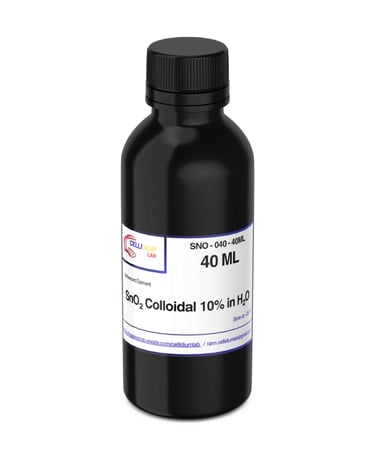
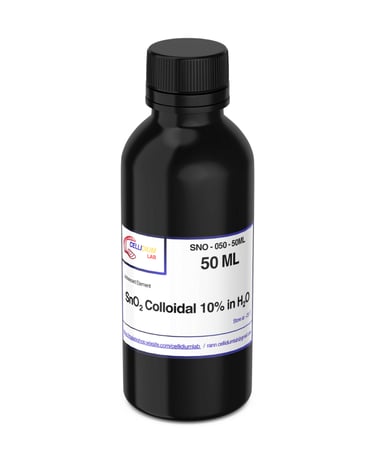
SnO₂ Colloidal 10% in H₂O
Tin dioxide (SnO₂) is a versatile material with a wide range of benefits and applications due to its unique physical, chemical, optical, and electrical properties. SnO₂ is a multifunctional material prized for its chemical stability, photocatalytic efficiency, gas sensing capability, and environmental safety, making it valuable in sensors, environmental remediation, energy storage, and optoelectronics.
Read more here.
Check out our SnO₂ Colloidal 5% in H₂O !


Quantity:
20 ML
40 ML
50 ML
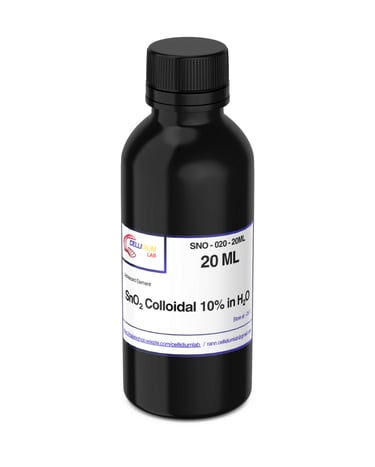
SnO₂ Colloidal 5% in H₂O
Tin dioxide (SnO₂) is a versatile material with a wide range of benefits and applications due to its unique physical, chemical, optical, and electrical properties. SnO₂ is a multifunctional material prized for its chemical stability, photocatalytic efficiency, gas sensing capability, and environmental safety, making it valuable in sensors, environmental remediation, energy storage, and optoelectronics.
Read more here.

Quantity:
100 ML
SnO2 is a transparent, wide bandgap n-type semiconductor with a tetragonal rutile structure, notable for its sensitivity to doping and defects which modulate its electrical and optical properties for diverse technological applications.
Crystal structure: crystallizes in the tetragonal rutile structure, commonly as a polycrystalline material or as single-crystal nanowires with diameters around 30-200 nm and lengths up to tens of micrometers.
Semiconductor properties: n-type semiconductor with a wide bandgap of about 3.6 eV that can vary depending on the polymorph (rutile, cubic, orthorhombic).
Optical characteristics: high transparency in the visible spectrum, with optical band gaps typically in the range of 3.16 to 3.93 eV, depending on synthesis and doping.
Electrical properties: SnO2 often shows semiconducting behavior and can have high carrier concentration.
Surface and morphology: can be synthesized in nanoscale forms such as nanowires, nanoparticles, and thin films with smooth or granular surfaces.
Chemical and defect behavior: oxygen vacancies are an important characteristic, affecting conductivity and sensor response.
Due to its electrical, optical, and structural properties, SnO2 is widely used in gas sensors, photovoltaics (as a buffer layer), hydrogen production photoanodes, and resistive switching memory devices.
TiO₂ Colloidal 10% in H₂O
Titanium dioxide (TiO₂), also known as titania, is an inorganic compound derived from titanium. It is a white, odorless, and absorbent solid, insoluble in water, and occurs naturally in several crystalline forms—most notably rutile and anatase. TiO₂ is renowned for its high refractive index, brightness, and opacity, making it the most widely used white pigment globally. It is also valued for its chemical stability, non-toxicity at standard concentrations, and photocatalytic properties. Read more here.

Quantity:
20 ML
40 ML
50 ML
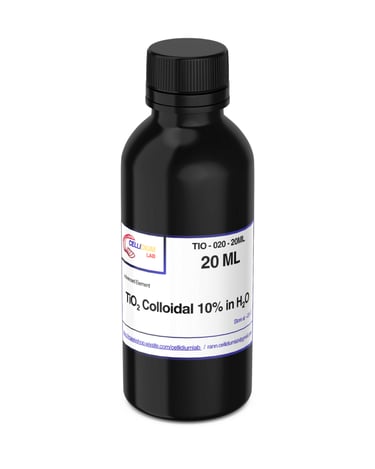
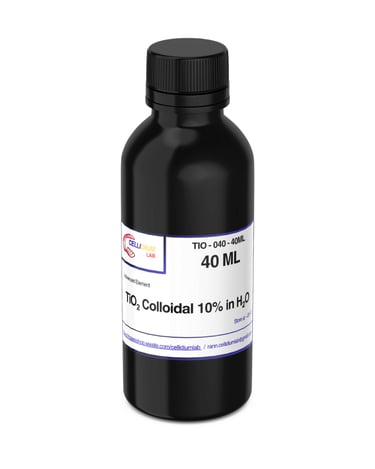
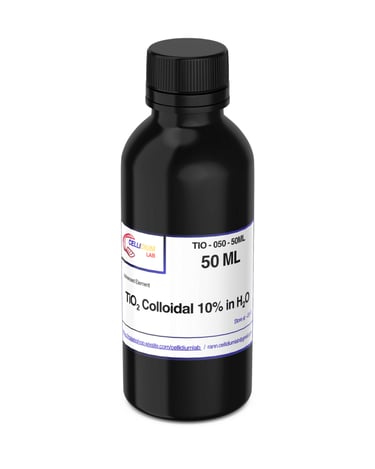
TiO2 is a versatile material characterized by its polymorphism, nanoscale particle size, wide bandgap semiconductor nature, strong UV absorption with photocatalytic activity, mechanical reinforcement capabilities in composites, chemical stability, and tunable optical/electronic properties through doping or reduction treatments. These characteristics make it useful for photocatalysis, environmental cleanup, composites, photovoltaics, and biomedical applications.
Crystal structure: crystallizes in three polymorphs—anatase (tetragonal), rutile (tetragonal), and brookite (orthorhombic)—each with different stability and properties.
Semiconductor properties: diamagnetic in pure form but shows ferromagnetic behavior when doped (e.g., with cobalt).
Optical characteristics: wide bandgap of about 3.0 to 3.4 eV, making it a strong absorber of UV light (200–350 nm), but with low absorption in the visible spectrum.
Photocatalytic activity: used as a photocatalyst due to its ability to generate electron-hole pairs under UV light.
Surface and morphology: can be synthesized down to nanoscale sizes (e.g., ~25 nm) with spherical morphology.
Mechanical properties: TiO2 nanoparticles as reinforcement in composites (e.g., with aluminum alloys) improve microhardness, tensile strength, and wear resistance significantly due to good dispersion and bonding with matrices.
TiO2 is chemically stable, non-toxic, and biocompatible, making it suitable for various applications including food packaging, environmental treatment, and biomedical uses.